GEO for local businesses: where to start with AI search
Help customers find accurate information about your business in AI search. Start with your profiles, your service pages and the questions people ask before they call.

Imagine someone asking an AI assistant for a roofer in your town. Could it find where you work, which jobs you take on and how to contact you? Would those details agree across your website and business listings?
Those are useful questions to start with. Before you commission more content, make sure the information you already publish helps a customer choose you.
What GEO means for a local business
GEO stands for generative engine optimization: making your business and its information easier to find and use in AI answers. You will also hear it called AI SEO or AEO.
Much of the work is familiar. Google's guidance says its usual SEO practices still apply to AI Overviews and AI Mode. There is no special schema or extra AI file you need to qualify.
That does not guarantee a mention. It gives you a sensible place to start: clear, accessible information that answers a real customer's question.
What citation studies can tell you
Ahrefs' September 2026 study examined Google AI Overviews across more than three million US queries. YouTube led its list of cited domains.
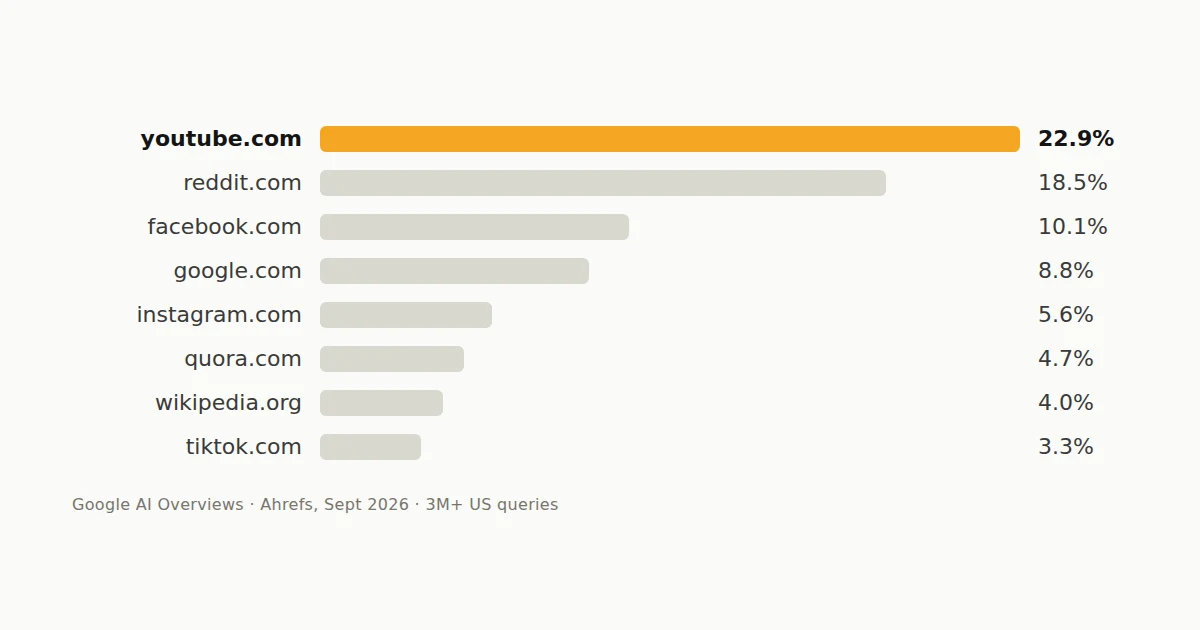
Read the percentages carefully: they are shares of citations among the top 50 domains in that study, not shares of all AI answers. The searches also cover many subjects, not just local businesses.
Use this as context, not a list of platforms you must join. A roofer in Leeds and a restaurant in Lyon may be found through quite different sources. Look at the answers to questions in your own market before deciding where to spend time.
Seven useful steps for this month
1. Check your business details
Review your Google Business Profile, Bing Places listing and website. Make sure the name, phone number, opening hours and service area agree. Add current photos and remove services you no longer offer. Invite customers to leave honest reviews in their own words.
2. Make your service pages useful
Give each main service a page that explains who it is for, where you offer it and what affects the price. For example, a roof repair page could cover the faults you handle, the area you travel to and what a customer should send when requesting a quote.
Only add separate town pages when you have useful local detail to share. Replacing the town name in the same paragraph does little to help a visitor.
3. Answer the questions you hear every week
Use recent calls and emails to build a short FAQ. Do customers ask about call-out charges, appointment times or what a quote includes? Answer those questions plainly. If your site uses structured data, keep it consistent with the visible information. Special FAQ markup is not a requirement for Google's AI features.
4. Check whether search engines can find your pages
Ask whoever manages your website to check it in Google Search Console and Bing Webmaster Tools. Submit a sitemap and investigate important pages that are missing. Submitting a page is a discovery step, not a promise that it will be indexed or cited.
5. Check for accidental access blocks
Have your web developer review robots.txt, noindex settings and firewall rules. Explain which search services you want to appear in before changing anything. For Google's AI search features, Googlebot and Search preview controls apply. Search access and AI training permissions are separate questions.
6. Put effort into relevant local mentions
Check your trade association, local directories and partner pages for missing or outdated details. Join community discussions when you can give a useful answer. Focus on places your customers actually use; posting the same sales pitch across forums helps nobody.
7. Make one helpful video, if you have the time
Choose a question that benefits from a demonstration, such as what happens during a roof inspection. Give the answer early, use clear chapters and include a written explanation on your site. Make it as long as the explanation needs, without padding.
Otterly.AI's study looked at more than 100 million citation instances across several AI services. Within its YouTube results, long-form videos accounted for 94% of citations and Shorts for 5.7%.
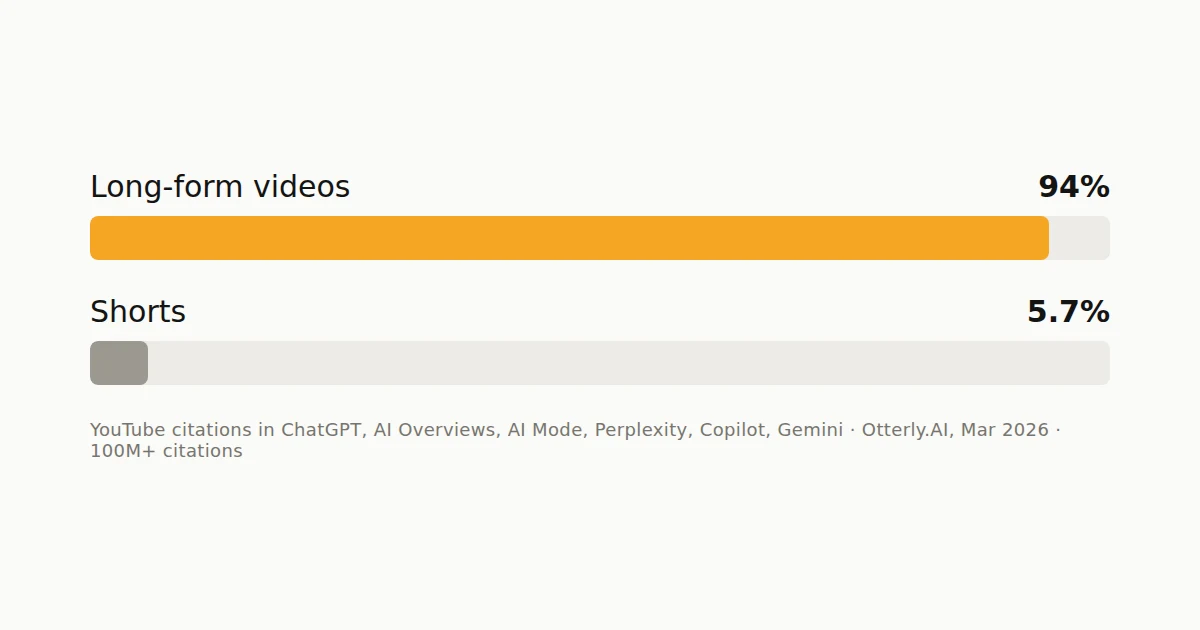
That is an observation about the study's sample. It does not show that making a longer video causes more citations, or predict how your own video will perform.
Where short videos fit
Short videos can introduce your business, answer a quick question or give people a reason to follow you. Measure them by the audience and enquiries they bring. The studies above do not establish that a regular Shorts schedule improves AI visibility.
We make Ravenclip, which turns news in your field into short videos. It may help if you want to maintain that kind of channel. It does not replace your service pages, your own examples of work or accurate business listings.
A manageable first-month plan
- Week one: correct your main profiles and record the questions customers ask.
- Week two: improve your most important service page and its answers.
- Week three: check indexing and update a few relevant directory listings.
- Week four: repeat a small set of searches and review enquiries. Add a video only if the basics are covered.
How to tell whether anything is changing
Keep a simple record of the question, date, service used, location, businesses named and sources linked. Repeat the same questions over time. Answers vary by wording, location and session, so one appearance or absence proves little.
Track visits and enquiries alongside mentions, and ask new customers how they found you. There is no dependable deadline for getting cited. The first useful result may simply be fewer customers calling with questions your website should already answer.
GEO questions
Is GEO different from local SEO?
There is substantial overlap. GEO focuses on visibility inside AI answers, while local SEO also covers maps and conventional search results. Accurate profiles, helpful pages and accessible content support both.
Do I need special AI markup?
Google says there is no special schema or AI file required for AI Overviews or AI Mode. If you use structured data, it should match the information people can read on the page.
Should I create a page for every town I serve?
Only when each page offers useful local information. A clear service-area page is more helpful than many near-identical pages with different town names.
Will YouTube Shorts get my business cited?
They might, but do not build your plan around it. Shorts accounted for 5.7% of YouTube citations in the Otterly.AI study cited above. That does not measure the chance of any individual Short being cited.
How long does GEO take?
There is no reliable timetable. Check periodically, keep a record and measure enquiries as well as mentions. Improved pages can help customers even before you see a change in AI answers.
What should I do first if I have very little time?
Correct your opening hours, contact details and service area. Then improve the page for your most important service using the questions customers ask before booking.
Keep reading
- Faceless.video review: is it the right tool for your channel?
- OpusClip review: is it the right tool for your videos?