YouTube Shorts not getting views? What we learned from 14 videos
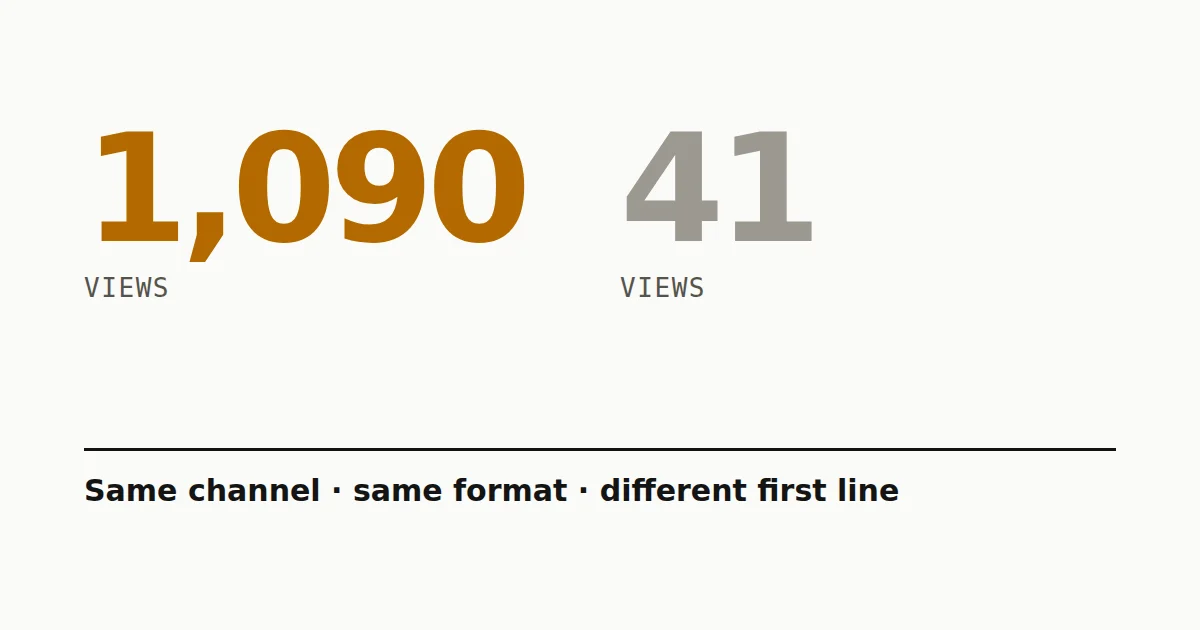
One Short reached 1,090 views. Another stopped at 41. Both used the same production format on the same channel. We looked at their opening lines for clues, then worked out what to test next.
It is frustrating to finish a Short, publish it and watch the counter barely move. When the next one does better, it is tempting to credit a new caption style or a different posting time.
We had a useful chance to look closer: 14 Shorts on one channel, made with the same production format, with very different results. The clearer, more concrete openings tended to appear on the videos with more views.
That makes the opening worth testing. It does not mean a weak first sentence explains every low-view Short. Here is what we found and how you can use it without guessing at the algorithm.
Start by checking where viewers drop out
Before rewriting anything, open the Short's analytics in YouTube Studio. A low view count can hide several different problems:
| What you see | What to check next |
|---|---|
| Little exposure in the Shorts feed | Confirm the video is public and check for restrictions. Review the topic and traffic sources before blaming the opening. |
| Viewers swipe away rather than watch | Review the first frame, spoken line and on-screen text together. Is the subject clear immediately? |
| Viewers start watching but leave early | Look for a slow introduction, confusing detail or a promise the video takes too long to deliver. |
YouTube's Shorts analytics guidance explains feed exposure and the share of viewers who watch rather than swipe away. Compare those figures with your own similar Shorts, instead of chasing a universal target.
Also check which kind of view you are counting. Since 31 March 2025, public Shorts views count starts and replays without a minimum watch time. Engaged views remains a separate measure of viewers who continued watching (YouTube's explanation). A public view count alone cannot tell you whether the opening held someone's attention.
What we compared
We make Ravenclip, which turns news stories into short videos. This sample comes from a customer's channel run by a Canadian SEO agency, with about 6,400 subscribers at the time.
The channel had 20 live Ravenclip Shorts published between 9 and 25 September 2026, alongside 27 Shorts the agency had produced itself. We recorded the public view counts on 25 September.
For the main comparison, we kept the 14 Ravenclip Shorts that were at least three days old. This excluded the newest uploads, but it did not give every video an equal amount of time to collect views. Three days was our cutoff for this snapshot, not a deadline for a Short to succeed.
These 14 videos used the same AI voice, caption style and production template. They ran from 24 to 42 seconds. Their stories, opening lines and story-specific visuals differed, so this was an observational comparison rather than a controlled test.
Clearer openings stood out in this sample
We grouped the first lines by how much background knowledge we thought a viewer needed: a concrete situation, an industry-specific story, or something in between. The chart uses shorter labels for those judgments.
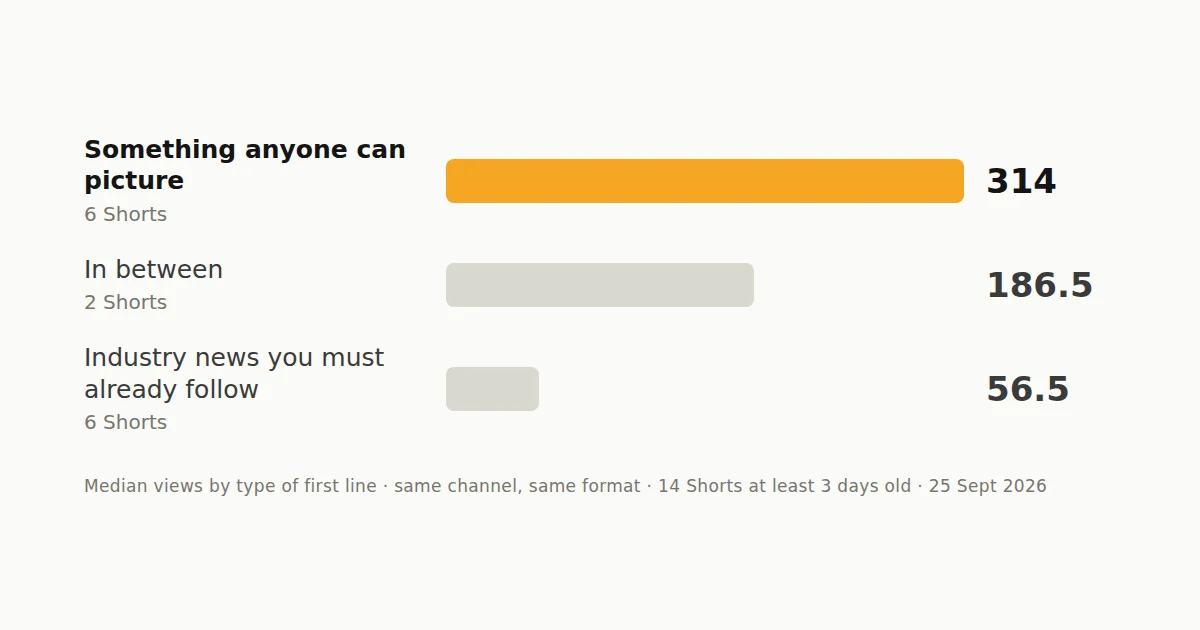
The six openings in the “anyone can picture it” group had a median of 314 views. The six in the “industry news” group had a median of 56.5. The remaining two had a median of 186.5. A median is the middle value after sorting the counts; for these even-sized groups, it is the average of the middle two.
Even the lowest-viewed video in the first group had more views than the highest in the industry group. That caught our attention. Here are all 14 so you can judge the categories yourself:
| Views | First line | Group |
|---|---|---|
| 1,090 | A camper searching Google Maps found a massive ancient crater. | Anyone can picture it |
| 528 | This AMD AI workstation saves eleven thousand dollars yearly. | Anyone can picture it |
| 329 | Half of global shipping containers use this contested strait. | Anyone can picture it |
| 299 | One 1996 map app is surging in downloads. | Anyone can picture it |
| 207 | Google's AI is citing drug spam from a city website. | Anyone can picture it |
| 193 | If you are a tech business hiring abroad, Canada changed the rules. | In between |
| 180 | ASUS just launched its first-ever Gemini AI laptop. | In between |
| 102 | A Canadian school gave a toddler a Google account. | Anyone can picture it |
| 86 | Google just signed a twenty-two year nuclear deal. | Industry news |
| 66 | Can Canadian businesses survive the U.S. trade war? Kristen Hillman has answers. | Industry news |
| 57 | Google DeepMind wants to replace search ranking with one LLM. | Industry news |
| 56 | Your team spends eight hours updating one recurring deck, according to Presentations.AI. | Industry news |
| 45 | Three massive international consortiums just got shortlisted for the Arctic. | Industry news |
| 41 | One single advertiser bought over thirteen percent of ChatGPT's ads. | Industry news |
The camper opening gives you a person, an action and an unexpected discovery. You can follow it without knowing anything about search marketing. “Replace search ranking with one LLM” asks for more background before the story makes sense.
But the categories are subjective. You might reasonably put the line about eight hours spent on a presentation in the concrete group. We assigned these labels while reviewing the results, which leaves room for our expectations to influence the grouping.
Our working hypothesis is that an accessible story and a clear opening helped these videos reach more people. We cannot separate the wording from the appeal of the story itself. We also do not have the retention or swipe-away data needed to check how viewers responded.
What the subscriber count and video length tell us
The 14 Ravenclip Shorts had a median of 141 views. The agency's 27 other Shorts had a median of 45.
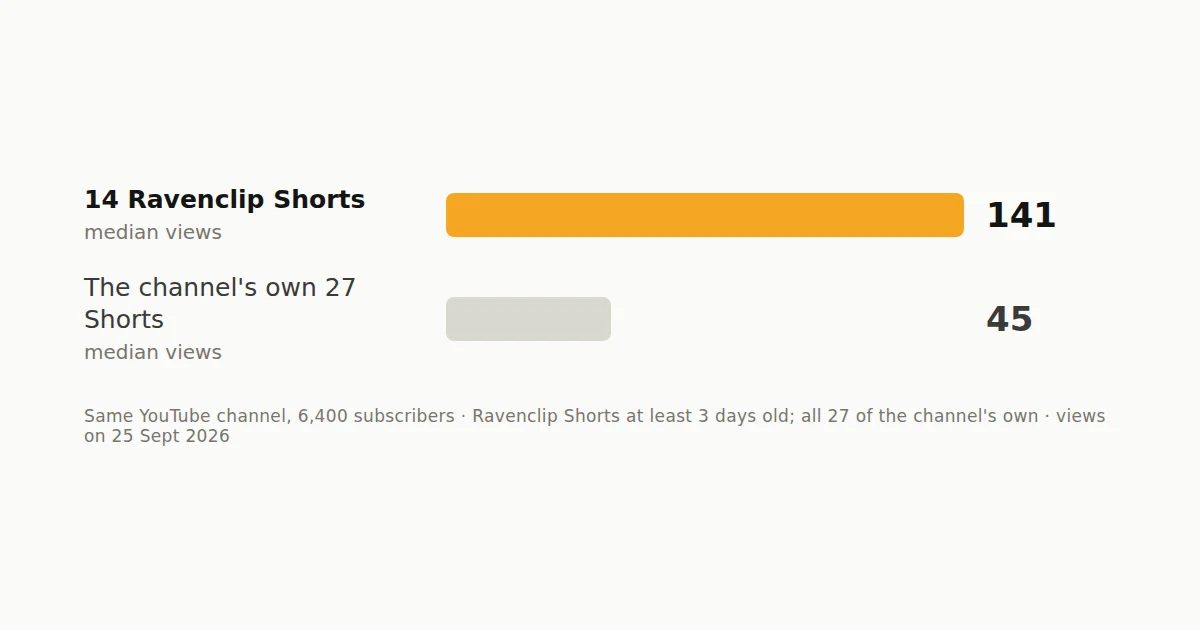
Those figures show that 6,400 subscribers did not guarantee thousands of views for every upload. They do not show that subscribers are unimportant, or establish that Ravenclip caused the higher median. The two sets were not matched for topic, publication date or time online.
YouTube describes Shorts recommendations as a combination of viewer interests and performance signals, including whether people choose to watch and how long they stay. Topic demand and competition also affect reach. Shorts can appear in the subscriptions tab as well as the feed (YouTube's discovery guidance).
Length gave us no obvious answer either. Two 24-second Shorts received 57 and 299 views; the longest, at 42 seconds, received 329. That is too little evidence to choose an ideal duration. For your next video, focus on giving the story enough room while cutting any setup the viewer does not need.
Write an opening your intended viewer can follow
You do not need to make every topic appeal to everyone. A specialist channel can use specialist language. The useful question is whether the people you want to reach can understand why this particular story matters.
Try these changes before recording:
- Start with the person, object or event. “A camper searching Google Maps found a massive ancient crater” gives the viewer a scene to imagine.
- Bring the interesting detail forward. Read your draft and find the point you would mention first when telling a friend. See whether it belongs in the opening.
- Explain unfamiliar terms through their consequence. If a story is about an AI model changing search rankings, explain what would change for the viewer, provided the source supports it.
- Give numbers a meaning. A time saving or a cost needs context: for whom, compared with what, and according to which source? Keep those qualifications when they matter.
- Match the first image to the sentence. Preview the opening with and without sound. The captions and visuals should help someone follow the same story.
For a hypothetical video about a delayed rail project, compare “An update on regional transport infrastructure” with “The new station will open a year later than planned.” The second gives the viewer the news immediately. Use that wording only if the delay is confirmed.
A clearer opening should help the viewer understand the story. Avoid making it more dramatic than the facts allow, and deliver what it promises in the rest of the video.
A useful test for your next few Shorts
Choose a recurring topic your audience already cares about. Write two possible openings for each new script, then pick the one that makes the event and its relevance clearest.
Keep the production style and approximate length steady while you work on the opening. Record the topic, first line, duration and publication date. Check each video's analytics after the same amount of time, such as three days and again after a week. Those are comparison points, not expiry dates.
Look at views alongside feed exposure, the share who stayed to watch and retention. If people start staying but leave halfway through, work on the explanation and pacing next. If several clearer openings show no improvement, revisit the topic and audience fit.
This will still be an imperfect comparison because every story is different. It gives you a more useful basis for the next edit than one unusually successful upload.
If you want help drafting alternatives, our free hook generator can give you starting points. Ravenclip handles news-based video creation and scheduled publishing. You still need to check the facts and judge whether the story suits your audience.
How to read these results
The table preserves the public counts and first lines recorded for this article. We have kept the customer anonymous, so it is not a linked dataset readers can independently recheck.
The main limits are worth keeping in mind:
- One channel, 14 videos. A pattern here may not carry over to your niche or audience.
- Different stories and upload dates. The first sentence was only one of several things that changed.
- Editorial categories. We judged the openings after the results were available, rather than defining a test in advance.
- Public views only. We did not measure engaged views, retention, swipe-away rate or traffic sources.
Use the pattern to choose something to test. Your own audience data should guide what you do after that.
Questions about Shorts views
Why are my YouTube Shorts not getting views?
Start by checking whether they receive feed exposure, whether viewers choose to watch and where they leave. A confusing opening is one possibility, but topic interest, audience fit and competition also matter. The public view count alone cannot identify the cause.
How can I improve my next Short's opening?
Name the event or concrete situation early, make its relevance clear to your intended viewer and match the first image to the words. Then deliver the promised explanation. Compare several uploads before deciding a change worked.
Do subscribers help Shorts get views?
Subscribers can discover Shorts through their subscriptions, but a subscriber count does not promise a view count for each upload. Our one-channel sample cannot measure how much subscribers contributed to these results.
What is the best length for a Short?
This sample does not establish one. Videos of the same length had different view counts. Use enough time to explain the story, then review retention to see where your own viewers lose interest.
Should I judge a Short after three days?
Treat three days as a checkpoint. We used it to exclude brand-new uploads from our snapshot, not because every Short stops gaining views then. Compare videos at similar ages and review them again later.
Does this prove a better hook gets more views?
No. The more accessible openings were associated with higher public view counts in this sample, but the topics and visuals also differed. It is a reason to test clearer openings, not a promised increase in views.
Keep reading
- Faceless.video review: is it the right tool for your channel?
- OpusClip review: is it the right tool for your videos?